How to Know If Your Pigmentation Needs Medical Treatment
August 11, 2026
Urticaria Treatment: When Should Hives Be Evaluated? | Dermatologist in Mumbai.
September 4, 2026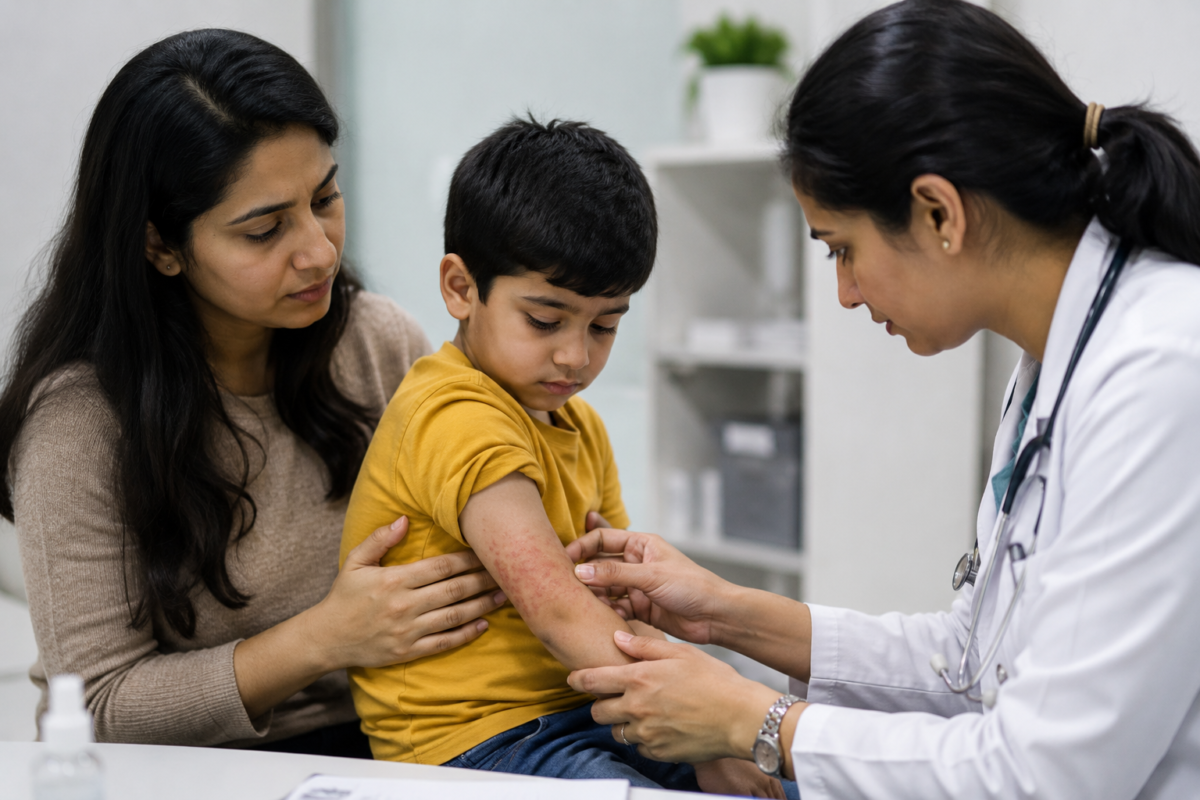
Children’s skin is delicate, and a rash, itching, dryness, or unusual patch can make parents understandably worried. But one of the biggest mistakes parents make is treating the visible symptom without understanding what is actually causing it.
A red rash may be eczema, an infection, an allergic reaction, irritation, or another skin condition. Using the wrong cream can sometimes hide the symptoms without treating the underlying problem.
If your child has persistent or recurring skin problems, getting the right diagnosis from a qualified pediatric dermatologist in Mira Road can help avoid unnecessary treatments and repeated flare-ups.
Why do children’s skin problems need special attention?
Children’s skin is not simply “adult skin in a smaller size.” Their skin can be more sensitive, and treatment choices may depend on the child’s age, the affected body area, the diagnosis, and the severity of the condition.
Common pediatric skin conditions include eczema, contact dermatitis, viral rashes, fungal infections, bacterial infections, acne in older children and teenagers, warts, molluscum contagiosum, insect-bite reactions, and various birthmarks.
The American Academy of Dermatology (AAD) notes that atopic dermatitis, commonly called eczema, is the most common pediatric skin disease and often causes itchy, dry, inflamed skin.
This is why treating a kid’s skin problems based only on a photograph, a relative’s experience, or a previously prescribed cream may not always be appropriate.
Mistake 1: Assuming every rash is an allergy
A rash does not automatically mean an allergy.
Skin rash in children can have many causes, including eczema, infections, irritation, insect bites, heat, and allergic reactions. The appearance alone may not always tell you the exact cause.
For example, itchy red patches could occur with eczema, while ring-shaped scaly patches may suggest a fungal infection. A rash accompanied by fever or other symptoms may need a completely different approach.
Instead of immediately searching for an “allergy cream,” parents should observe:
- When did the rash begin?
- Is it itchy, painful, scaly, or oozing?
- Is it spreading?
- Did the child develop fever?
- Did anything new come into contact with the skin?
- Is another family member experiencing similar symptoms?
These details can help a dermatologist determine the appropriate child skin problems treatment.
Mistake 2: Using an old prescription for a new rash
One of the most common mistakes is thinking, “This cream worked last time, so it should work again.”
Unfortunately, two rashes can look similar but have completely different causes.
A cream previously prescribed for eczema may not be appropriate for a fungal infection. Similarly, an antibiotic cream will not treat a fungal infection, and an antifungal will not treat eczema.
The AAD explains that antimicrobial medicines such as antibiotics, antivirals, and antifungals treat infections; they do not treat eczema itself.
If your child’s skin condition keeps returning, it is better to reassess the diagnosis rather than repeatedly restarting an old prescription.
Mistake 3: Applying steroid creams without professional guidance
Steroid creams can be highly effective for certain inflammatory skin conditions, including eczema. The problem is not that steroids are inherently “bad”; the problem is using the wrong strength, amount, location, or duration without medical guidance.
Children can be more sensitive to these medicines than adults. The AAD recommends using topical corticosteroids in children only according to a dermatologist’s treatment plan. When used as directed, these medicines can be safe and effective.
Parents should be especially careful with combination creams purchased without proper medical advice.
If a cream contains a steroid, antibiotic, antifungal, or combination of medicines, don’t assume it is suitable simply because someone recommended it.
A dermatologist for children in Mira Road can determine whether a topical medicine is appropriate and how it should be used.
Mistake 4: Trying too many home remedies
Parents often want to help quickly, especially when a child is uncomfortable.
But applying multiple home remedies can irritate already-sensitive skin and make it harder to determine what caused the problem.
Ingredients such as lemon juice, toothpaste, essential oils, undiluted vinegar, or strongly fragranced products can irritate the skin. “Natural” does not automatically mean “safe for every child.”
For sensitive skin in children, a simple routine is often better: gentle cleansing, appropriate moisturization, and treatment recommended for the specific condition.
When eczema is involved, the AAD recommends gentle bathing practices and moisturizers, particularly fragrance-free products, as part of skin care.
Sometimes the best skincare routine is the one with fewer ingredients—not a bathroom shelf that looks like a chemistry laboratory.
Mistake 5: Stopping eczema treatment as soon as the skin looks better
Eczema often improves and then flares again.
Parents may stop treatment immediately when the redness and itching disappear. However, eczema management usually involves more than treating visible symptoms during a flare.
The AAD recommends a comprehensive approach that can include skin care, moisturization, trigger management, and medication when needed.
Regular moisturizing can help maintain the skin barrier and reduce dryness. Depending on the child’s condition, a dermatologist may also recommend a specific maintenance plan.
Eczema is treatable, but there is currently no simple permanent “one-time cure.” Some children eventually outgrow it, while others continue to experience flares.
That makes long-term management and follow-up important for children with recurring skin problems in children.
Mistake 6: Over-bathing or using harsh soaps
Clean skin does not need to feel squeaky dry.
Frequent hot baths, harsh soaps, bubble baths, and heavily fragranced products can worsen dryness and irritation in children who already have sensitive skin.
For children with eczema-prone skin, the AAD recommends warm rather than hot water, keeping baths relatively short, using mild fragrance-free cleansers when needed, and moisturizing after bathing.
For dry skin in children, moisturizing regularly can be more useful than repeatedly washing the skin.
Parents should also pay attention to laundry products, fragrances, and fabrics if they notice that particular products consistently worsen irritation.
Mistake 7: Ignoring a possible skin infection
Not every itchy or red patch is eczema.
Children can develop fungal, bacterial, and viral skin infections. Some infections can spread between children, particularly in schools, playgrounds, sports settings, and households.
Signs that may warrant medical evaluation include:
- Rapidly spreading redness
- Increasing pain or swelling
- Pus or discharge
- Crusting or oozing
- Blisters
- Fever or the child appearing unwell
- A rash that keeps spreading despite treatment
Children with eczema can also have an increased risk of skin infections, according to the AAD.
If you suspect a skin infection in children, avoid randomly applying several creams and seek professional advice.
Mistake 8: Restricting foods without a proper medical reason
Food is often blamed whenever a child’s eczema or rash flares.
However, removing multiple foods from a child’s diet without medical guidance can create unnecessary nutritional restrictions. A food allergy and eczema are related but are not automatically the same thing.
The AAD’s 2026 pediatric atopic dermatitis guidelines found insufficient evidence or no benefit for several dietary or environmental interventions as general eczema-prevention strategies.
If you suspect that a particular food causes a reaction, discuss the pattern with your child’s pediatrician or dermatologist rather than eliminating multiple foods based on internet advice.
Mistake 9: Scrubbing, scratching, or peeling affected skin
When a child has scaling, dryness, or a patch that looks unusual, parents may try to scrub it away.
This can damage the skin barrier and increase irritation.
Children with eczema may also scratch intensely because the condition can cause significant itching. Scratching can further damage the skin and may increase the risk of infection.
Keeping nails short and using appropriate moisturizers can help reduce the effects of scratching. For persistent itchy skin in children, identifying and treating the underlying cause remains the priority.
Mistake 10: Waiting too long when a rash keeps coming back
A one-time mild rash may settle without extensive treatment. But recurring skin problems in children deserve closer attention.
If the same rash repeatedly returns, it is worth asking why.
Possibilities may include eczema, contact dermatitis, recurrent infection, an environmental trigger, or another underlying skin condition. Repeatedly treating the symptoms without identifying the cause can lead to frustration for both parents and children.
A consultation with a children’s skin specialist in Mira Road can help establish a diagnosis and create a treatment plan suited to the child’s age and skin type.
When should parents take a child to a dermatologist?
Parents should consider professional evaluation when a skin problem is persistent, recurrent, spreading, painful, infected-looking, or affecting the child’s sleep, school activities, or quality of life.
A dermatologist can examine the pattern, distribution, texture, and other clinical features of the skin condition and decide whether further testing or treatment is necessary.
Urgent medical attention is important when a child has a rash together with serious symptoms such as difficulty breathing, swelling of the lips or tongue, confusion, severe illness, or a non-blanching rash. The NHS advises urgent assessment for children with concerning rashes and symptoms such as breathing difficulty, altered responsiveness, or a rash that does not fade when pressed.
Do not wait for a routine skin appointment if your child appears seriously unwell.
How can parents safely manage common skin problems in children?
The best approach is usually simple: identify the problem first, then follow an age-appropriate treatment plan.
Parents can support healthy skin by:
Keep skincare gentle
Use mild, fragrance-free products when appropriate, especially if your child has sensitive or eczema-prone skin.
Moisturize regularly
For children prone to eczema or dryness, regular moisturizing can support the skin barrier and help reduce flare-ups.
Avoid unnecessary medication
Do not use antibiotics, antifungals, steroid creams, or combination medicines simply because they worked for another person.
Watch for triggers
Keep track of new soaps, detergents, cosmetics, fabrics, environmental exposures, or activities that seem to coincide with flare-ups.
Follow the prescribed treatment
If your child has been evaluated by a dermatologist, follow the treatment schedule rather than stopping or changing medicines based solely on whether the skin looks better.
Why is the right diagnosis more important than the strongest cream?
A stronger medicine is not necessarily a better medicine.
The right treatment depends on the diagnosis, the child’s age, the body area involved, the severity of the condition, and whether infection or another problem is present.
For example, treatment for eczema differs from treatment for a fungal infection. Similarly, children’s skin allergy treatment depends on whether the child actually has an allergic condition and what is triggering it.
This is why responsible dermatology focuses first on diagnosis and then on targeted treatment.
Looking for a pediatric dermatologist in Mira Road?
Parents searching for a pediatric dermatologist in Mira Road Mumbai, child dermatologist in Mumbai, or children’s skin specialist in Mira Road should look for a qualified dermatologist experienced in evaluating children’s skin conditions.
At SkinHealth by Dr. Safa Patrick, parents can seek dermatological evaluation for concerns such as eczema, rashes, pigmentation, infections, allergies, itching, acne, warts, and other common skin problems in children.
The goal is not simply to make a rash disappear temporarily. It is to understand why it developed, choose an appropriate treatment, and help parents manage the child’s skin safely.
If your child has a persistent or recurring skin problem, avoid experimenting with multiple creams. A professional assessment can often save time, reduce unnecessary treatment, and give parents a clearer path forward.
Frequently Asked Questions
What are the most common skin problems in children?
Common concerns include eczema, contact dermatitis, viral rashes, fungal infections, bacterial infections, insect-bite reactions, warts, molluscum contagiosum, and acne in older children and teenagers.
Can I use my child’s old skin prescription again?
Not without checking with a healthcare professional. A new rash may have a different cause, even if it looks similar to an earlier problem.
Are steroid creams safe for children?
Topical corticosteroids can be safe and effective when the correct medicine, strength, amount, body site, and duration are selected and used as directed.
What should I do for itchy skin in children?
First, identify the cause of the itching. Gentle skincare and moisturization may help some conditions, but persistent or severe itching requires evaluation rather than repeated self-treatment.
When should I see a dermatologist for my child?
Consider an appointment when a rash is persistent, recurrent, spreading, painful, associated with infection, or affecting your child’s sleep or daily activities. Seek urgent care when a rash occurs with serious symptoms such as breathing difficulty or significant illness.
Can eczema be cured permanently?
There is currently no simple permanent cure for eczema. However, it can often be controlled effectively with appropriate skincare, trigger management, and medical treatment when necessary. Some children eventually outgrow the condition.
Should parents eliminate foods to treat eczema?
Parents should not unnecessarily remove foods from a child’s diet without medical guidance. The latest AAD pediatric eczema guidelines do not support several commonly promoted dietary interventions as general prevention strategies.
Final Takeaway
The biggest mistake parents can make with children’s skin problems is assuming that every rash needs the same cream.
Children’s skin deserves a thoughtful, diagnosis-first approach. Avoid unnecessary home remedies, don’t reuse old prescriptions without guidance, don’t ignore recurring symptoms, and seek professional evaluation when a skin problem persists or looks unusual.
For parents looking for a pediatric dermatologist in Mira Road, child skin specialist in Mira Road, or dermatologist for children in Mira Road, timely evaluation can make treatment more focused, safer, and less stressful for both the child and the family.